“People are realizing you need to do something”
Published 9:59 pm Wednesday, June 24, 2026
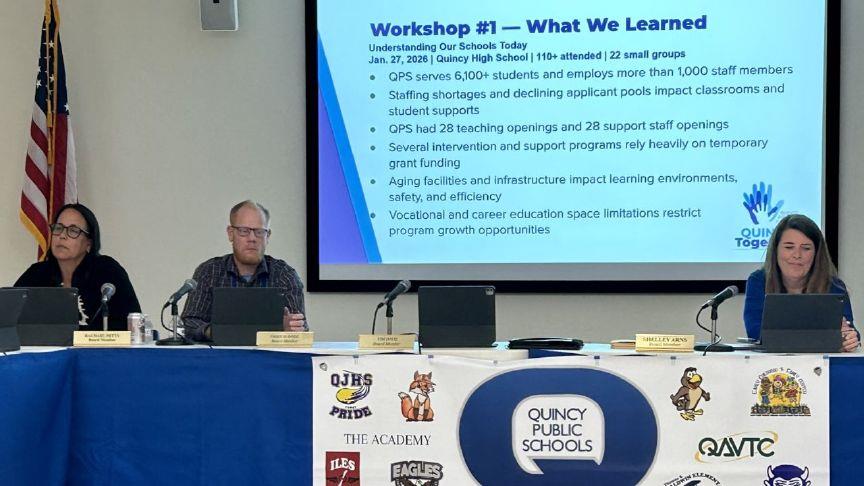
QUINCY — A survey tied to the Quincy Together community engagement effort found widespread support that a strong public school district is essential for Quincy being a great place to live, work, and raise a family.
That 93.2% of respondents strongly or somewhat agreed with the statement surprised even Jennifer Volk, president and chief executive officer of St. Louis-based Discovery Works Collaborative, which has worked with Quincy Public Schools (QPS) over the past year.
“People truly value the impact that the district has on the community as a whole,” Volk said in presenting a synopsis of survey findings Wednesday night to the School Board.
Just over 1,600 residents responded to the survey, agreeing that QPS is falling behind other districts with respect to teacher compensation, supporting public schools is one of the best ways to protect property values, and preferring to fund school improvements with sales taxes rather than property taxes.
“People are realizing you need to do something,” Volk said. “Even though it may not be the best time, this is something we need to look at.”
Survey results prioritized district staffing needs, avoiding deficit spending, and salaries and benefits — the same priorities highlighted in the Quincy Together effort.
“Quincy Together was designed to be a community-led process focused on the future of QPS,” said Sandra Hite, a co-chair of the community engagement process. “The goal was not simply to identify problems but to build shared understanding and identify possible paths forward.”
Quincy Together co-chairs Ryan Sparks, Martin McCarthy, and Hite presented the effort’s final report and community recommendations to the board, reviewing a process designed to explore district needs, challenges, and priorities focused on the future of QPS.
“Where we’re at now certainly isn’t the end. This is just the beginning,” Sparks said. “But the goal from the get-go was to make sure the public had a voice and, similar to what they’re bringing up, there was trust and transparency being established. I believe this has gone a long ways to help with that.”
The School Board took no action on the recommendations.
Board members focused “more on listening,” Board President Shelley Arns said, but she hopes to see the board act at the July 15 meeting.
“We figure out what the best option is going to be to serve the community,” board member Curtis Sethaler said. “We’re excited to go over that data and see what we can do to continue to make this the best district possible.”
McCarthy said the process offered a way to open people’s eyes to where the district is today and what it needs in the future.
“What I saw validated through the workshops really makes me hopeful that people realize how valuable our schools are for our broader community whether or not you have kids currently in the schools or the school district,” McCarthy said. “It really benefits our entire community.”
The Quincy Together effort began in July 2025 with a charge to gather community input, understand district challenges, explore future opportunities, develop long-range priorities, build shared understanding, and make recommendations to the Board of Education.
Five workshops with an average attendance of 75, building tours and open houses, small-group feedback activities, and the survey gave community members opportunities to weigh in on the future of QPS.
Priorities outlined in the process include competitive salaries and staff retention, expanded student supports, safe and updated facilities, career and workforce opportunities, long-term financial stability, and ongoing community engagement.
Facilitators reviewed with board members information provided, and what organizers heard from the public, at each workshop, and highlighted four options presented for moving forward — increasing the Education Fund rate, using a County School Facilities Sales Tax, a combination of the Education Fund increase and the sales tax, and making cuts.
The combined approach emerged as the most preferred option in the sessions, and one of seven recommendations to the board asks it to present the community with a proposal for additional funding that protects students and staff, maintains facilities, and supports long-term financial stability.
That recommendation, like the others first presented at May’s workshop, is general rather than specific.
“We don’t dive into the specifics or the mechanics. We’re going to lean on the board to come up with those,” Sparks said.
“There are some significant things about increasing funding, about taking care of teachers and staff, making our schools more competitive,” McCarthy said. “There’s real weight behind them in that they do represent such a strong voice from the community. There’s a few things there that I think should really happen for our community.”
The seven recommendations call on the board to present the Quincy community with a proposal for additional funding that reflects the Quincy Together priorities, protects students and staff, maintains facilities, and supports long-term financial stability. The report also urges the board to develop and communicate a clear financial plan outlining how new funding would be used, how progress would be measured, and how the community can hold the district accountable.
Additional recommendations encourage the district to continue rebuilding trust and transparency through honest communication and stakeholder engagement, clearly explain the urgency of its financial situation and the consequences of inaction, prioritize the recruitment and retention of qualified educators and staff through competitive salaries and benefits, remain focused on community priorities such as student discipline, teacher support systems, and learning environments, and use community partnerships to expand resources and strengthen career and workforce pathways.
Adams County Clerk Ryan Niekamp said school districts have until Aug. 17 to act on resolutions to put a referendum question on the Nov. 3 ballot.
“They would then show that to the regional superintendent. She would act as the local election authority for this issue. She would need to file that with my office by Aug. 27,” Niekamp said. “If they decide to do anything in the consolidated election (April 6, 2027), all those dates would get pushed to the end of January.”
Sparks definitely wants to see the board take steps to improve the district’s situation.
“I truly believe that status quo is going to have some ramifications that will negatively impact the schools and our community. I want to be able to see us get out in front of that, be more proactive than reactive,” he said. “I believe a stronger QPS does make for a stronger Quincy and future prospects of not only our community but for those considering possibly moving here.”
In other action, the School Board approved a request from Quincy Junior High School to pilot new English language arts and math curriculum in the 2026-27 school year. The board also recognized nine high school spring sports athletes in boys tennis and track and field who qualified for state competition.
After a public hearing, board members adopted amended 2025-26 budgets for the Quincy school district, West Central Region, Quincy Area Vocational Technical Center, and Special Education Association.
The board approved a health-life-safety amendment tied to electrical system upgrades at Quincy High School. The amendment increases by $213,600 the $2.9 million project cost to replace four transformers. The additional cost covers work by Ameren Illinois, slated for next summer, to bring electrical power from its substation at QHS to a nearby pole to connect to the project upgrades.
Board members also adopted 2026-27 school handbooks and set meeting dates for the 2026-27 school year: July 15, Aug. 26, Sept. 30, Oct. 28, Nov. 18, Dec. 16, Jan. 27, Feb. 24, March 24, April 28, May 19, and June 23. All meetings begin at 6 p.m. in Room 214 of the Board of Education Office, 1416 Maine.