Solar development continues to walk the line of power needs and community concerns
Published 12:00 am Saturday, June 27, 2026
QUINCY — As demand continues to grow for power needs from both commercial and residential customers, developers see opportunity for growth in the Prairie State as Illinois currently ranks sixth in the nation in solar energy.
According to a second-quarter report issued by the Solar Energy Industries Association (SEIA), even with overall solar capacity declining in the nation, residential capacity increased by about 6% from the same period in 2025.
According to the report, solar and the accompanying battery storage systems accounted for more than 90% of all new electrical generation coming online in the first quarter of 2026.
In total, Illinois has installed enough solar power to run over a million homes. Installations range from the simple roof-top style systems to the full, utility-scale solar farms.
“Solar provides that power while overlapping with a remarkably small amount of land,” Andrew Linhares said. Linhares is the director of Midwest state affairs for SEIA. “Solar is currently located on just 0.05% of all land in Illinois. The solar and storage industry is committed to thoughtful development that balances critically needed energy production, agricultural priorities, conservation, and community input.”
Pivot Energy, a solar company putting up a number of solar farms in the Quincy and Adams County area, shared data that substantially more property that’s considered “prime farmland” is in use by golf courses across the country than what solar panels occupy.
The report provided by Pivot shows that, on a national level, around 0.07% of prime land is currently occupied by solar facility, while nearly 0.2% of that land has golf courses installed. While the percentage remains low, the land used by golf courses is nearly three times as much as solar occupies.
One common argument used by opponents of the solar development is that they facilities make agricultural land otherwise unusable. SEIA officials note that solar construction is designed from the beginning to be temporary, with farms having an expected lifespan of 20-30 years before decommissioning, as opposed to more permanent development like commercial or even residential facilities.
In addition, many of the solar facilities are designed with dual-use capability even during the solar generating lifespan.
“Solar development and agriculture thrive side-by-side while creating shared value for rural communities,” Linhares said. “Many solar projects support dual-use agricultural practices such as grazing and pollinator habitats.”
Property used to construct solar facilities are not taken out of use by methods such and eminent domain or other methods of coercion to landowners. Solar builders contract with the landowners, providing a steady source of land-lease income while maintaining the ownership of the land itself. Landowners are able to determine the best route for themselves on how their land is being used and developed.
Even during the construction phase, energy companies work with local bodies to minimize impacts. Adams County Engineer James Frankenhoff, who heads the county’s Highway Department, said agreements have been established between the developers and township road districts directly for proper use, and exclusion, of certain roads near solar sites, citing an agreement in place between the Melrose Township and Pivot Energy.
“The agreement restricts what roads in Melrose Township can be used by Pivot Energy contractors and suppliers during construction of the solar energy facility on Ghost Hollow Road,” Frankenhoff said.
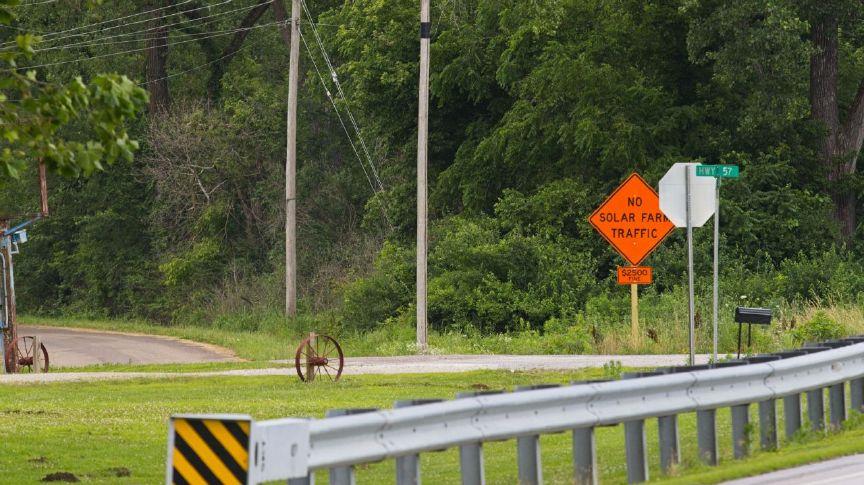
Drivers in the area may see temporary signs in place barring traffic for the construction projects on certain roads around the construction sites. These signs make note of penalties in the event of violations.
“The signs are only enforceable between Melrose Road District and Pivot Energy,” Frankenhoff noted.
As energy demands continue to grow, state officials in Illinois are also taking steps to reduce environmental impacts of electrical generation with closures of coal-fired plants. Linhares said the gulf between demand and supply is growing.
“New technologies like data centers, advanced manufacturing, and the increasing electrification of everyday life are driving up energy demand, risking a supply crunch and raising people’s electricity bills,” he said. “For context, ComEd’s peak energy demand in the summer is around 24 GW, and data centers alone are requesting 28 GW. So, we need to double our power in a very short time span.”
Linhares said that solar provides an opportunity to generate the needed electrical capacity at both a fast and cost-effective rate to supply those growing demands.
“We need more power, and we need it fast, he said. “Gas, coal, and nuclear are all much more expensive and take years longer to get online (while they) often face construction and supply chain delays.”
SEIA also works to promote the safety of solar projects with concerns over issues that could arise after the expected lifespan of facilities comes to an end.
“Innovators across the solar industry are working every day to make this technology and industry as efficient and sustainable as possible,” Linhares said. “What happens after a project meets the end of its useful operation depends on myriad (factors, though), and requires thoughtful engagement with the landowner, the company or companies involved, and the surrounding community.”
With the state passing the Clean and Reliable Grid Affordability Act, one key fact was to build not only solar generation facilities, but the power storage capacity to go along with it. One commitment made in the legislation was to provide at least 3GW of energy storage, a move that is expected to same Illinois residents more than $13 billion in energy costs over the next two decades, according to the Illinois Power Agency.
“If we want to get out of the energy affordability crisis, solar and storage are the fastest, most effective way to do so,” Linhares said.
The Adams County Board will host public hearing on July 22 on a new development proposal in the Riverside Township. The facility proposed would cover around 16 acres with the capacity of 2.5MWAC once completed.