Rare clock with Quincy ties displayed at Pennsylvania museum
Published 10:14 am Friday, July 24, 2026
QUINCY — A piece of Quincy history has found a new home in the National Association of Watch and Clock Collectors Museum (NAWCC).
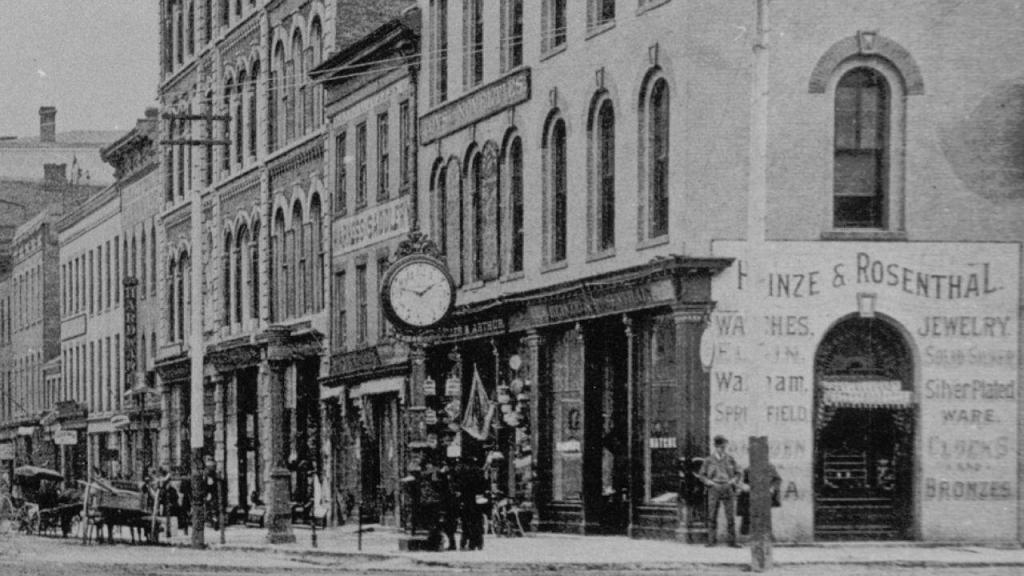
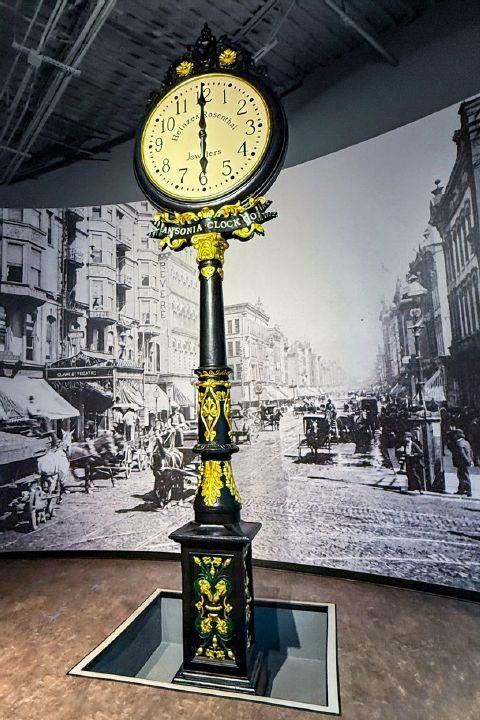
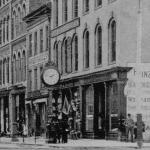
A dedication ceremony will take place Saturday at the Columbia, Pennsylvania, museum for a street clock made by the Ansonia Clock Company, nicknamed “Quincy,” which stood on North Fifth Street from 1887 to around 1918.
“It’s a fascinating story that it was in Quincy so many years ago and even more fascinating to me that this clock has survived all those years and now we have it on permanent display,” said Don Bugh, president of NAWCC’s Tower and Street Clock Chapter. “That’s wonderful that we were able to save a piece of United States history and Quincy history.”
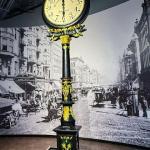
The Brooklyn, N.Y.-based clock company made street and tower clocks for a 10-year period in the 1880s, vying with Seth Thomas and E. Howard Clock Co. for business. “In order to compete, they made their clock taller by a foot and also made it much more ornate than what the other two companies made,” Bugh said.
But Ansonia didn’t protect the clock’s wooden dial behind glass, leading to maintenance issues, “and rather than redesign the clock, they just stopped that line of production and went on to other clocks,” said Bugh, a Texas man whose interest in antique clocks dates to the 1990s. “They produced lots and lots of wall clocks, mantel clocks. They were better at doing that than tower and street clocks.”
Bugh said only three Ansonia street clocks remain — one in California, one in Missouri, and Quincy in the association’s museum.
“It is still all original, has all its original ornamentation. It’s an extremely rare clock,” Bugh said. “To find one that existed all these years in the original condition is just incredible. That’s why we wanted to preserve this one in our museum.”
NAWCC, which dates to 1943 with a membership of about 9,000 worldwide, primarily in the United States, opened the museum in 1977. The association displays the 19-foot-tall Quincy in a specially designed space adjacent to the museum’s Public Time Gallery.
Americans for years relied on “public time” — the street clocks like Quincy and tower clocks installed in courthouses and other large buildings.
“A lot of people did not have a watch, a pocket watch, and they needed a way to determine what the time was. Wristwatches really didn’t become popular until after World War I,” Bugh said. “The street clocks and tower clocks were very important just to provide a time resource.”
Jewelers often placed a street clock in front of their stores “because people could associate time and watches that they would sell in their stores,” Bugh said. “With Quincy on the Mississippi River, there were a lot of steamboats. People visiting Quincy would walk up into the downtown area. What better way to advertise a jewelry store than to have a big street clock they could see almost immediately when they were walking into town?”
The idea appealed to Oscar Heinze and Joseph Rosenthal, owners of Heinze and Rosenthal Jewelry, which moved in 1886 to 500 Maine, the southeast corner of Fifth and Maine. The next year, the jewelers bought the two-dial Ansonia clock and installed it in front of the store.
By 1894, the clock had moved to 118 N. Fifth, where it stood in front of M. Huffman Jewelry, then Trask and Plain Jewelers, and Odell Jewelers. Around 1918, the clock was sold to W.B. McLane and shipped to Memphis, Mo., where it stood in front of McLane Jewelry and then Laird Jewelry.
Quincy then made stops in New Mexico and Florida before NAWCC acquired the clock in 2013 and moved it to the association’s headquarters for display in a new gallery as a “crown jewel” of the museum.
“We were able to raise the funds to renovate the area and to get the clock finally restored. All that is done,” Bugh said. “She’ll finally be standing tall at the NAWCC Museum after 12 years of working on this project.”
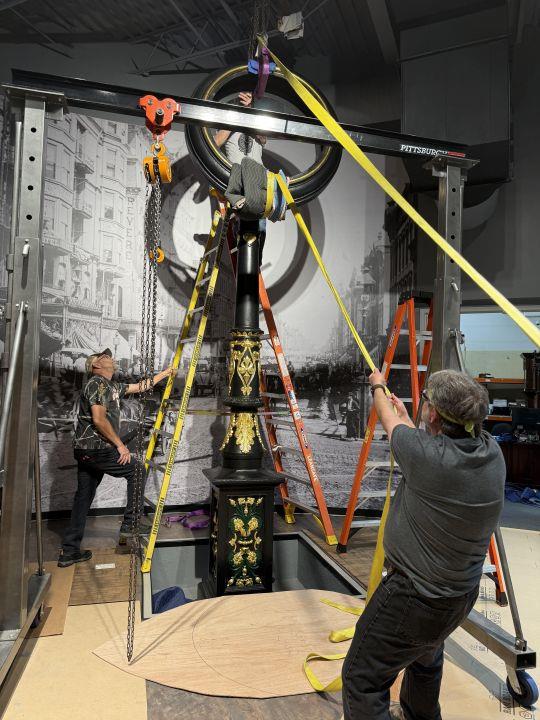
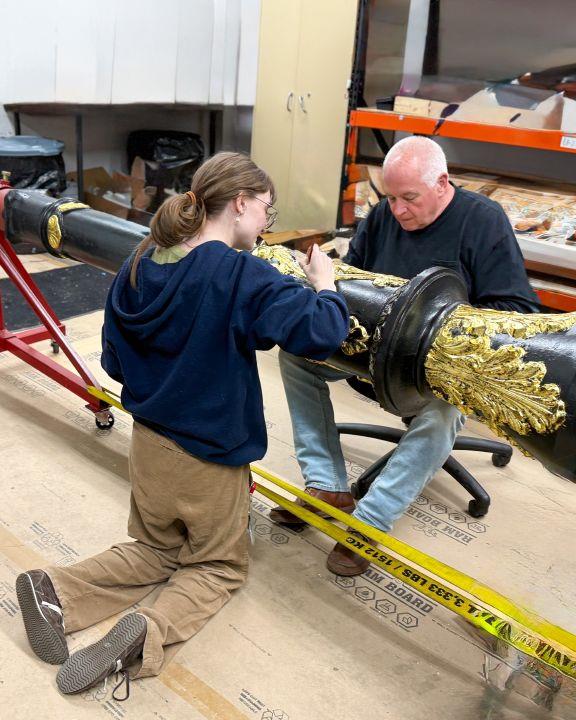
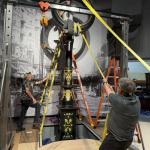
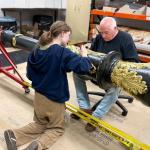
Twenty-three volunteers, including Bugh — all interested in street and tower clocks, their history, and their restoration — gathered in Pennsylvania in April for “Quincy Week” to gild the clock case, erect the clock, and attach the movement ahead of the dedication.
“This project has been very exciting,” Bugh said. “We’re very pleased and very proud to have her standing at last.”
TIMELINE
The National Association of Watch and Clock Collectors shared a timeline of the 139-year history of the Ansonia Street Clock “Quincy” including:
• 1886 — Oscar Heinze and Joseph Rosenthal move Heinze and Rosenthal Jewelry to 500 Maine.
• 1887 — Heinze and Rosenthal buy a two-dial street clock from Ansonia Clock Company and install it in front of the store.
• 1894 — Quincy moves to 118 North Fifth where it stands in front of M. Huffman Jewelers, then Trask and Plain Jewelers and Odell Jewelers.
• 1918 — Quincy sold and shipped to Memphis, Mo., where it stands in front of McLane Jewelry Store, then Laird Jewelry.
• 1957 — A city road maintainer removing heavy snow from the Memphis public square knocks down the clock. The broken cast iron frame is repaired in Keokuk, Iowa, before Quincy is reinstalled in May 1961 in front of Laird Jewelry.
• 1969 — Quincy sold to Charles Bottom, a private clock collector from Los Alamos, New Mexico, who displays the clock in his backyard.
• 1980 — Stan Good of Tampa, Fla., buys Quincy from Bottom and installs the clock in front of his store, Stan Good Clocks.
• 2013 — NAWCC buys Quincy after Good’s death, disassembles the clock and moves it in January 2014 to the association’s headquarters in Columbia, Penn.
• 2025 — New gallery proposed at NAWCC’s Museum to display Quincy. Construction begins along with clock restoration work.
• April 26, 2026 — Quincy set in place in new gallery.
• July 25, 2026 — Dedication ceremony scheduled for Quincy at the NAWCC Museum.