Council approves funding restrictions on shooting park, adds EV chargers
Published 9:40 pm Monday, July 27, 2026
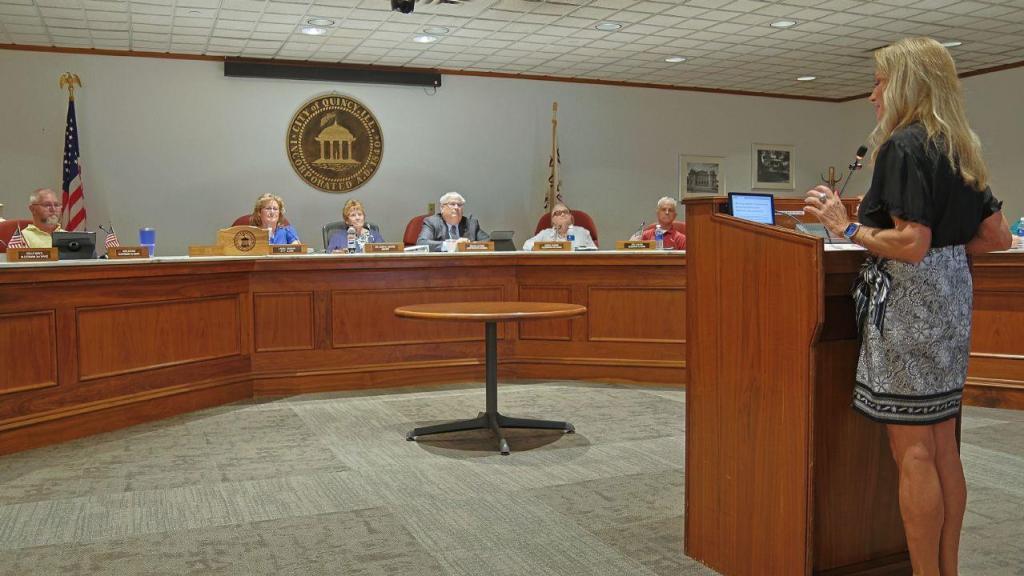
QUINCY — The Quincy City Council passed a resolution at Monday’s meeting to set the guardrails in place over funding for new Quincy Clay Sports Park.
The trap and clay shooting property, intended to be built on the site of the former Moorman Manufacturing research farm near Fowler, will be required to pay its own way once it’s up and running.
The resolution passed on Monday declared that the city will not use any tax revenue to support the facility other than using the city’s Food and Beverage tax fund as a guarantee for the loan that will be used for construction. The resolution notes that the Clay Sports Park will not be eligible for city budget subsidies like those used by the Oakley-Lindsay Center or the Quincy Public Library, among others.
Mayor Linda Moore said once the construction is completed, the income earned from the facility use will be used to pay off the construction loans, ensuring that even the Food and Beverage tax is only used as collateral, not for actual payments other than in early phases while the facility is still under construction.
A number of speakers continued to voice opposition to the park, including one speaker who didn’t understand how the city could spend just under $3 million to purchase the land, approved by the council at the July 20 meeting, when there are other needs like infrastructure work needed within the city.
The ordinance passed at that previous meeting used current fund balances from the Food and Beverage tax revenues to pay for the purchase. Those funds – more than $5 million at the start of the new fiscal year on May 1 – cannot be used for road work or other similar projects. When the council passed the tax, it was for the stated purpose of finding ways to increase opportunities to draw people to Quincy.
Funds in the Food and Beverage tax have been used to provide funding to efforts like Freedom Fest, the Quincy Grand Prix, and Gem City Concerts among others.
The Food and Beverage tax, created in May 2020, was updated in May 2025 to include a provision that would force the council to reconsider the tax in 2030. At Monday’s meeting, the council heard the first reading of an ordinance update that would extend the tax through 2049 in order for it to be used as loan collateral.
Moore confirmed that the change does not lock future councils into that date. If the construction and development loan is paid off early, the council can revisit the tax at any time with no early-pay penalties.
The council voted 9-4 to accept a bid $52,070.05 from Brown Electric to install two electric vehicle charging stations. The chargers will be installed at City Parking Lots D and F. Lot D is located near Seventh and Vermont, next to Awerkamp Machine, while Lot F is the city lot at Fifth and Vermont across for the Salvation Army’s Kroc Center.
City Engineer Steve Bange said no city funds are being used for this project. Instead, these are funds that were offered in the form of a grant from Ameren Electric that was not sought by the city but was instead volunteered by the utility company.
“This was the easiest grant we’ve ever gotten,” Bange said. “We didn’t even ask for it.”
The total grant of $75,000 is intended to help improve infrastructure and support for electric vehicle usage. Bange said the three major options presented as ideas from Ameren included the chargers, city-operated vehicles, or training for firefighters to learn how to handle emergencies related to electric vehicles.
Ald. Eric Entrup, R-1, said the discussion held in committee focused on the chargers over fleet vehicles because maintenance of EVs by the city could add additional layers of complexity to the city’s fleet maintainers.
Bange did let the council know there are annual fees associated with the billing and management of the chargers, but he anticipates income from people using the devices will allow the city to break even on those costs.
Ald. Greg Fletcher, R-1, Jeff Bergman, R-2, Glen Ebbing, R-5, and Jake Reed, R-6 voted against the project, while Tony Sassen, R-4, recused himself.
In other business, the council:
•Approved the appointment of Rachel Doerhoff to replace Angela Caldwell on the Board of Fire and Police Commissioners. Caldwell announced that she will step down from the board in August, with Doerhoff taking her seat through the end of her term in 2029.
•Approved a city easement to allow ADM to run a new outfall sewer line to carry the company’s non-contact cooling water from just south of Lock & Dam Road to the river. ADM currently uses an old, abandon city sewer line but is required to upgrade to meet environmental constraints.