New plan addresses statewide math challenges
Published 8:35 am Thursday, July 2, 2026
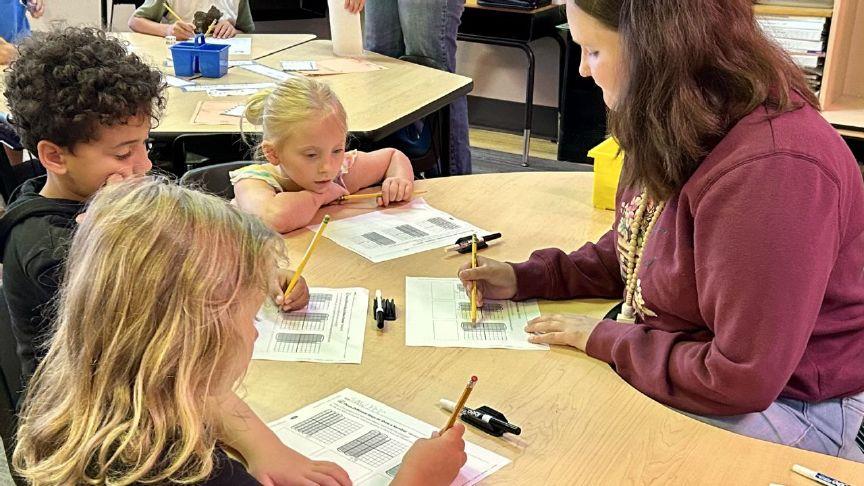
QUINCY — Looking at Illinois Assessment of Readiness scores, Pikeland Superintendent Russ Tepen readily admits that third through eighth grade students didn’t land where the district wanted in math.
“Some things we’ve got put into place have really helped even though the numbers are not where we want to be — and will help us moving forward,” Tepen said.
A diagnostic tool, piloted in the 2025-26 year with expanded use planned for 2026-27, sets students on individualized paths to build on existing math skills to reach the next level of proficiency or mastery measured through ongoing assessment.
“Kids do a series of lessons during the week in addition to what they’re doing in the classroom,” Tepen said. “We know we’ve got some work to do.”
More help could come through the state’s first comprehensive numeracy plan to strengthen math teaching and learning for all students.
The plan builds on the success of the 2024 comprehensive literacy plan to respond to persistent statewide challenges in math achievement, including slower post-pandemic recovery in math and longstanding disparities across student groups, while aiming to reverse those trends by focusing on high-quality instruction, coherent learning progressions and targeted supports for students and educators.
“Pikeland, as well as most districts, has known for a long time that numeracy has been an area we’re going to have to target,” Tepen said. “I feel like we’re a little bit ahead of the game as opposed to other districts that waited to see what was coming out.”
The state plan sets goals for:
• Students to build and apply numeracy skills through tasks that develop reasoning, fluency and real-world problem solving.
• Educators to use evidence-based numeracy instructional strategies to strengthen students’ mathematical understanding and confidence.
• Leaders to promote a culture of numeracy through targeted professional learning and data-informed instructional support.
“It’s something all of us need to take a look at. Look at our curriculum, look at our professional development. Make sure it aligns,” Quincy Public Schools Elementary Education Director Erica Maynard said. “I don’t foresee a lot of changes at this point in time.”
QPS adopted new K-5 math curriculum for the 2024-25 year and will pilot new curriculum for the junior high in the 2026-27 year.
Maynard said the plan, just like the comprehensive literacy plan, offers guidance not governance without requiring specific materials or assessments.
“It gives us something as a district (for) understanding of what numeracy means and what it should look like in our classrooms,” Maynard said. “It clearly defines what they call numeracy, really the conceptual understanding behind math. It is shifting a little bit from what we would have thought of when we were younger — a lot of rote memorization and applying rote memorization. Now it’s really about mathematical thinking.”
The plan identifies six components of numeracy, the interacting strands that define mathematical proficiency and support math success for every learner.
“Numeracy is foundational to student success in school, careers and everyday life,” State Superintendent of Education Tony Sanders said in a news release. “This plan gives educators the tools and framework they need to ensure all students develop the skills and confidence to engage with math in meaningful ways.”
What is numeracy?
• Numeracy is the ability for all students to confidently understand, interpret and apply mathematical concepts across all domains of mathematics in a variety of real-world and academic contexts.
• It is communicating mathematical thinking, choosing and using appropriate mathematical tools, problem solving in unfamiliar situations using mathematical reasoning and for everyone.
• It is not solely computation/arithmetic, rote memorization, restricted to the math classroom, reserved for advanced math learners/courses and disconnected from lived experiences.
• Numeracy supports the development of a positive mathematical identity where students see themselves as capable, persistent and confident problem solvers.
Source: Illinois State Board of Education