Questions over interim police chief selection persist following Human Rights meeting
Published 10:34 pm Thursday, July 2, 2026
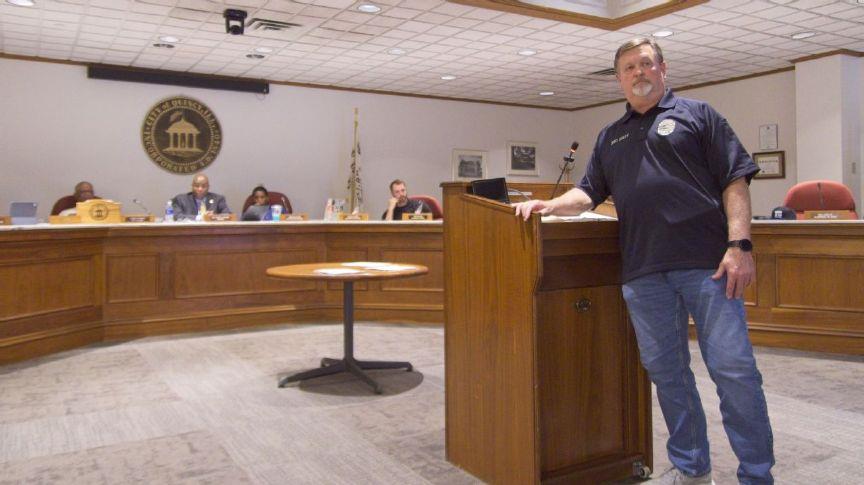
QUINCY — At Thursday’s meeting of the Quincy Human Rights Commission meeting, passions were high as citizens and commissioners raised questions about the prospective appointment of Robert T. Finney to temporarily lead the Quincy Police Department following Adam Yates’ retirement.
Finney, who served for nearly 17 years with the Quincy Police Department before retiring as a deputy Chief, was selected by the city’s three-member Board of Fire and Police Commissioners to step in as interim chief at QPD for around three months while a full-time replacement is selected.
Questions were raised on the appointment because Finney was on the scene of an officer-involved shooting 17 years ago during his tenure as chief of the Champaign Police Department. While it was determined that Finney had not fired his service weapon during the incident, he was there when a 15-year-old Black child, Kiwane Carrington, was killed.
Investigations by the Champaign County State’s Attorney, the Illinois State Police, including ballistics evidence, and the United States Department of Justice all determined that the shooting was a tragedy, but it was a result of an accidental discharge on the part of another officer on the scene, not Finney.
At the public meeting Thursday, Fire and Police Commission Chair Curt Kelty was asked when he became aware of the shooting and why it wasn’t considered during the vetting process for the interim chief.
“We were (obviously) not involved in the investigation,” Kelty said. “We’ve been relying on reports, and things that we’ve heard that have come out since.”
Quincy City Attorney Bruce Alford also stepped in to note that, as part of the hiring process, employment laws in the state bar prospective employers from searching for unofficial information on social media or other outlets when determining the eligibility of a any new hires.
“If you can’t Google anybody you’re hiring, how are you supposed to know anything about anyone’s history, besides what they put on their application?” one resident asked Alford.
“That’s what makes it so hard for us,” Alford said. “We often find out things about people after we hire them, that we did not know.”
Kelty said he had no interest in causing divisions through the city of Quincy, and it’s his belief that Finney’s entire history shows that this was an isolated incident as far as any official records show.
“I don’t want to see anything, personally, that would harm any relations between the police and anybody in this community,” he said. “Certainly, over the last 4 years, Chief Yates has done a great job of reaching out in this community, and the last thing that any of us would want to have happen is to have that damaged.”
Following the meeting, Kelty said he doesn’t know the answer to whether he would have recommended Finney if he’d had the complete record of the 2009 incident beforehand. He noted that even after Carrington was killed, Finney continued to serve as chief of police in Champaign for another three years. In the time since he left that job in 2012, Finney has also served as interim chief in five different departments.
“He has been in this same position, answered these questions, at least five other times,” Kelty said.
One point that Kelty, as well as Quincy Mayor Linda Moore, emphasized is that Finney is not in consideration to lead the Quincy Police Department on a full-time basis.
“You could call it a babysitter, if you want, or a substitute teacher for a few months,” Moore said.
Moore said the reports of the shooting were startling when she learned about them, but noted that decisions on leadership in positions like the chief of police, even on an interim basis, have to be based on official accounting of the candidate’s history.
“I had an emotional reaction when I read some of the headlines,” she said. “I understand the triggers, and I understand that this can be an emotional issue. And of course that concerns me. But I think we were all talking about a lot of speculation, not facts.”
Moore said she’s looking forward to the residents of Quincy having the opportunity to speak with Finney directly.
“I think he’s the only one that can address the facts specifically,” Moore sad. “I look forward to him getting here.”
Mark Philpot, chair of the Human Resources Commission, also said he’s looking forward to speaking with Finney in person.
“(We’re not trying to) re-adjudicate 2009, but we want to find out what the new interim chief has done since then,” Philpot said. “Has he attended any type of cultural sensitivity training? Has he attended any counseling based upon being involved in a very critical incident?”
Philpot, a former firefighter, noted that it’s a common practice for first responders involved in serious instance like the 2009 shooting to attend such training and debriefing efforts.
“We think that the Human Rights Commission serves as a portal to be able to connect the people to those that serve them,” Philpot said. “We’re looking forward to continuing that relationship with Finney, and whomever the next chief of police is.”
Rev. Carl Terry, a member of the HRC, said that he also looks forward to posing questions to Finney, including about his time with the Quincy Police Department, and why he wants to return after leaving in 1999.
“I would want to know why did he leave,” Terry said. “And why would he come back to a place he had chosen to leave? We have to have these types of conversations. We have to know what’s going on.”
According to a report from The Herald-Whig in 1999, Finney left Quincy when he was offered the position as chief of police in Carbondale, Ill., giving him the opportunity to lead a department of his own for the first time.
As of Thursday, Finney is set to take the interim position as of July 13. The choice in hiring for the position, as well as the full-time chief position, is left up to the three members of the Board of Fire and Police Commissioners. City officials, including the mayor’s office, aldermen, committees like the HRC, and other entities can contribute input.
The Quincy City Council will vote on the employment contract, but by city ordinance, the final decision is left to the Fire and Police commissioners.
The process for choosing chiefs of public service agencies came under scrutiny early in Mayor Michael Troup’s time in office. Troup has presented the Quincy City Council an ordinance change to allow the sitting mayor to have final say on chief appointments, but that change was tabled by the council and helped contribute to a vote of no confidence by the council in regard to Troup’s leadership.
Mayor Moore said she does not see any obvious need to change the process, but noted she will ensure that more feedback from the community will be a part of the selection process for the new full-time police chief.
“There will be a lot of due diligence, on a lot of different layers,” she said. “There will be community involvement, there will be council involvement, input from a number of sources will happen. But the decision will be made by the Board of Police and Fire Commissioners.”